The Evolution of a Sovereign Stack: From Filesystems to Spacetime
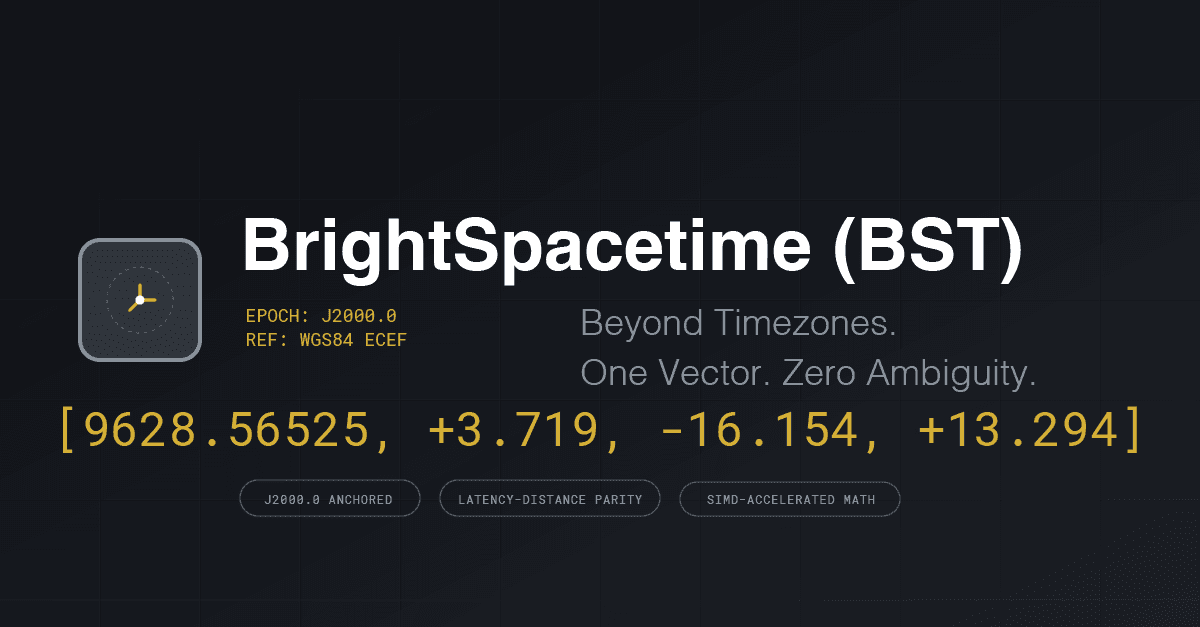
Most engineers start with a problem; I started with a 20-year vision for data sovereignty. What began as a decentralized filesystem (BrightChain) has evolved into a full-system overhaul of how we measure and interact with the physical world.
Here is how one architectural layer necessitated the next, and why these tools are becoming essential for high-performance engineering.
The Foundation: BrightChain It started with BrightChain, a decentralized, owner-free filesystem. When you build for absolute privacy and cryptographic sovereignty, you realize legacy systems—like time and location—are full of "leaky" abstractions and "Legacy Tax." To fix the filesystem, the environment it lived in had to be fixed first.
The Core Logic: BrightDate Distributed systems often struggle with the "if/else" complexity of timezones and leap seconds. This led to the creation of BrightDate—a decimal time protocol anchored to the J2000.0 epoch. By replacing legacy temporal complexity with a single universal scalar, we gained sub-microsecond precision across global nodes without the overhead of NTP-drift or DST offsets.
The Coordinate Shift: BrightSpace Geography was the next hurdle. Latitude and Longitude are non-linear; they "break" at the poles and require heavy trigonometry for simple distance math. This requirement resulted in BrightSpace, an ECEF-based grid using Bright-Meters (bm). One Bright-Meter is the distance light travels in exactly one SI second.
The Convergence: BrightSpacetime By unifying BrightDate and BrightSpace, we arrived at BrightSpacetime. Every event, file, and network packet is now a 4D vector [t, x, y, z].
The "Nice" Math: 1 millisecond = 1 Milli-Bright-Meter.
The Result: Space and Time finally use the same ruler.
The Toolset: Making it Genuinely Useful This isn't just theory; it's a functional terminal environment.
BSH (BrightShell): A high-performance shell that treats BrightDate as a native primitive. Your prompt isn't just a path; it’s a spacetime anchor.
Bright-Findutils: Re-engineered GNU tools (find, xargs) that allow for high-precision decimal filtering. Want to find files modified in the last 0.005 decidays? Now you can.
Bright-Iputils (bping): The ultimate truth-detector. It audits network latency against physical light-speed limits. Since Distance = Minimum Ping in our system, bping can mathematically detect proxy routing or location spoofing in real-time.
The Engineering Reality This isn't just about the math—it’s about efficiency. On Apple Silicon (M4 Max), our Euclidean BrightSpace math is significantly faster than legacy Haversine calculations, allowing for real-time spatial indexing at a planetary scale.
We are building a stack where the hardware, the software, and the physical laws of the universe are finally in sync.
Fixed in Space. Universal in Time. Defiant by Design.
#BrightChain #BrightDate #BrightSpace #SoftwareEngineering #Decentralized #SystemsArchitecture #RustLang #AppleSilicon #TechInnovation